Accounting in D365, Part 2: Raw Material to Finished Goods
In every manufacturing process, the transition from raw materials to finished goods involves critical stages, each contributing to operational and financial success. Here’s a breakdown of the key events in this cycle and the corresponding accounting entries in Dynamics 365 Finance & Operations (D365 F&O):
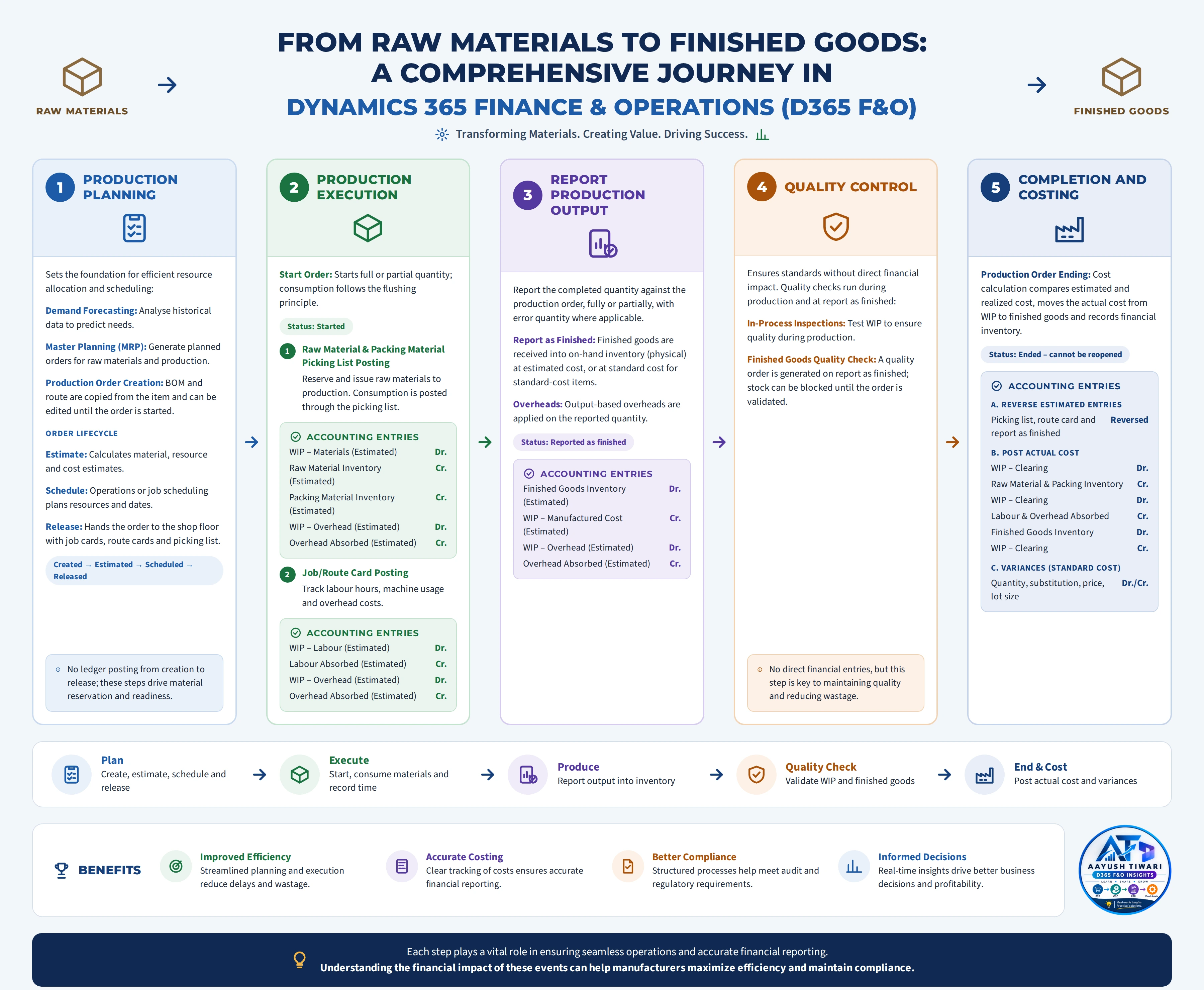
This is Part 2 of the Accounting in D365 series. It continues from Part 1 (Procure to Pay): part of the raw material purchased there is consumed in a production order that produces finished goods in legal entity INMF (currency INR). All vouchers are posted on 6 October 2026, the trial balance opens with the closing balances of Part 1, and the finished goods produced here are sold in Part 3 (Order to Cash).
The vouchers explained below are driven by a few key setups in D365 F&O, which should be validated before the cycle is executed:
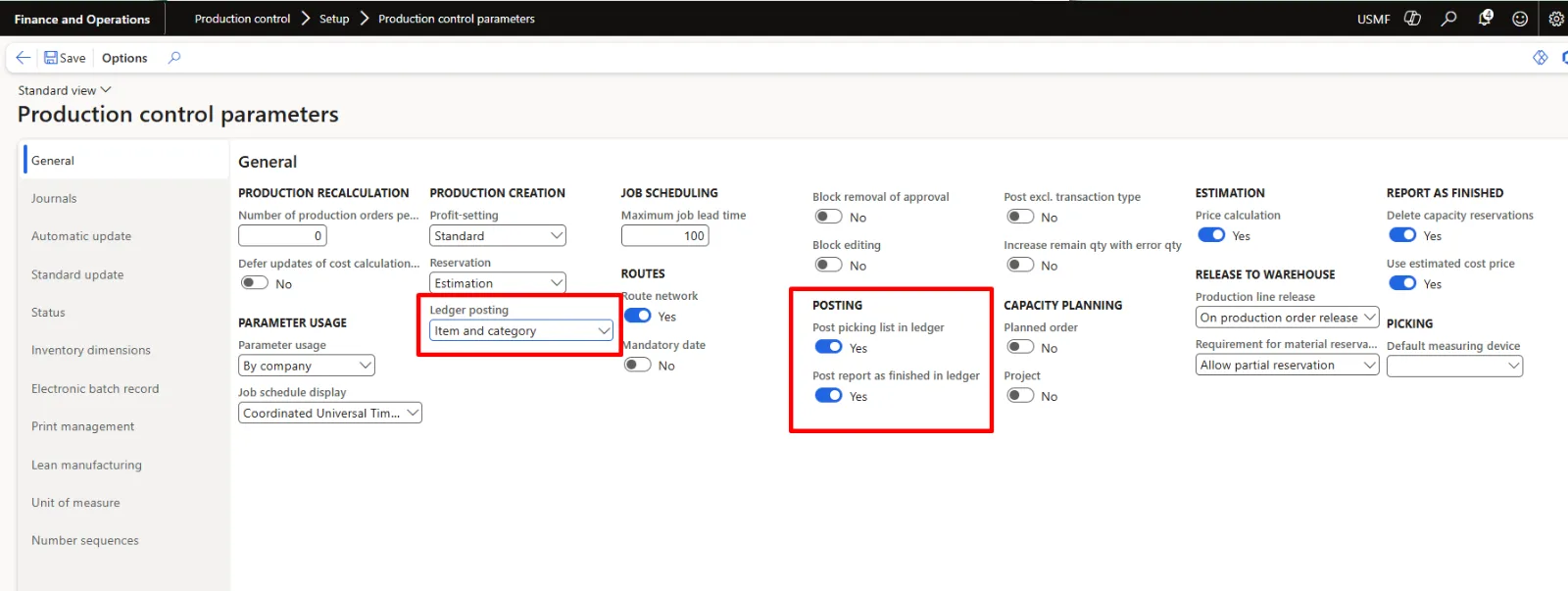
- Production control parameters – the Ledger posting option (Item and resource, Item and category, or Production order) decides where the production ledger accounts are picked from. The Start, Report as finished and End tabs control automatic BOM and route consumption, and whether picking list and route card journals are posted in ledger or not.
- Production control > Setup > Production control parameters.
- Item model group – defines the inventory model and “Post physical inventory” / “Post financial inventory”, which control whether production consumption and receipts update the general ledger.
- Production posting accounts – the Production tab of the Inventory posting profile (or the Production group, when ledger posting is set to Production order) maps posting types such as Picking list, Estimated cost of materials consumed WIP, Report as finished, Estimated manufactured cost WIP, Cost of materials consumed WIP, Manufactured cost and the production variance accounts to main accounts.
- Cost categories – hold the hourly cost for route operations and the ledger accounts for “Cost of manufacturing consumed, WIP” (Production WIP-Labor) and “Manufacturing cost absorbed” (Direct Labor Applied).
- Production control > Setup > Routes > Cost categories.
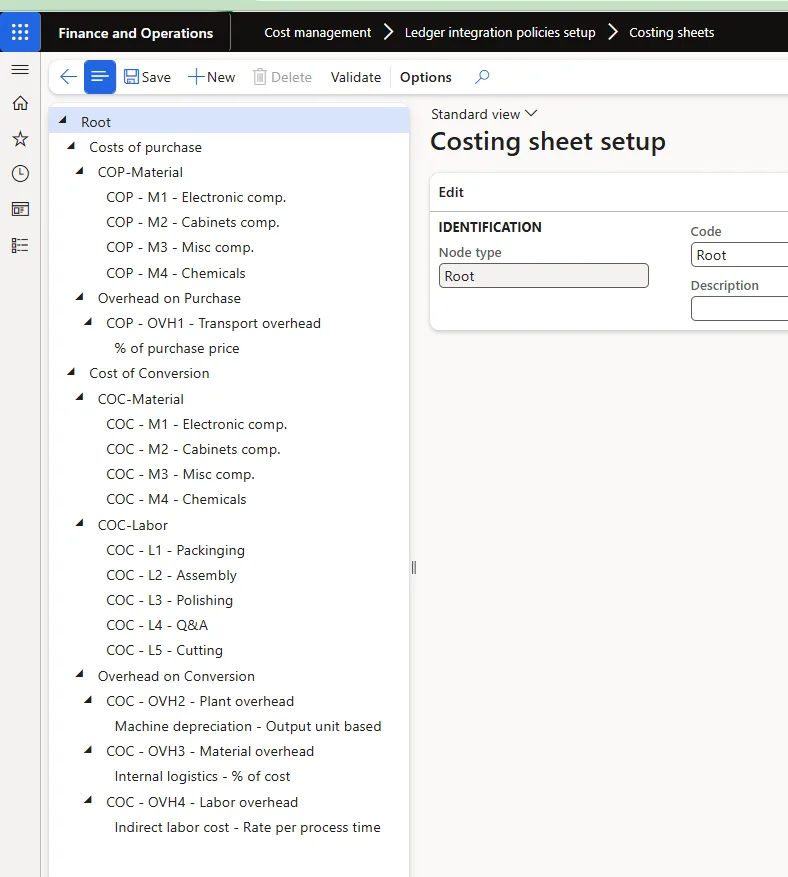
- Costing sheet and indirect costs – cost groups (M1–M3 material, L1–L4 labor, OVH2–OVH4 overhead) roll up the cost of conversion, while indirect cost codes apply overheads with their own WIP and absorption accounts. No indirect costs are applied in this example.
- Cost management > Inventory accounting policies setup > Costing sheets.
This stage sets the foundation for efficient resource allocation and scheduling:
- Demand Forecasting: Analyse historical data to predict needs.
- Master Planning (MRP): Generate planned orders for raw materials and production.
- Production Order Creation: Define the Bill of Materials (BOM) and routing.
1.1 Production Order Creation
- A production order is a request to produce a specific quantity of an item by a planned date. It is created by firming planned production orders from master planning, directly from a sales order line or a higher-level production order (pegged supply), or manually.
- Navigation: Production control > Production orders > All production orders > New production order.
- Enter the item number, quantity, delivery date, site and warehouse. The production BOM and route are copied to the order and can be edited until the order is started.
- The production status is set to Created.
1.2 Production Order Estimation
- Estimation calculates the material and resource consumption, the estimated cost price and the sales price of the order, and creates the inventory transactions for the BOM lines.
- Navigation: Production order > Production order tab > Process > Estimate. The result is reviewed under Manage costs > Calculations > Price calculation.
- The production status is set to Estimated.
1.3 Production Order Scheduling
- Scheduling plans when operations run and which resources perform them.
- Operations scheduling gives a rough plan at resource group level; Job scheduling breaks operations into individual jobs with dates, times and specific resources. Finite capacity and finite material options can be applied.
- Navigation: Production order > Schedule tab > Schedule operations / Schedule jobs.
- The production status is set to Scheduled.
1.4 Production Order Release
- Releasing hands the order over to the shop floor. Job cards, route cards and the picking list can be printed, and warehouse work for raw material picking is created where warehouse management processes are enabled.
- Navigation: Production order > Production order tab > Process > Release.
- The production status is set to Released. Only released orders can be started.
Note: No ledger voucher is posted at the planning, creation, estimation, scheduling or release stages; these activities are vital for material reservation and readiness.
This stage converts planned activities into actionable tasks, focusing on material usage and cost recording:
2.1 Start Production Order
- Starting the order records that production has begun for the full or a partial quantity.
- Navigation: Production order > Production order tab > Process > Start.
- On the Start dialog, select the quantity, the from/to operation and whether the picking list and route card journals should be posted now. Automatic BOM and route consumption follows the flushing principle (Start, Finish, Manual or Available at location).
- The production status is set to Started.
2.2 Raw Material & Packing Material Picking List Posting
- Reserve and issue raw materials to production. Consumption of raw material is done by picking list posting.
- Navigation: Production order > View tab > Journals > Picking list.
- The picking list journal is created per BOM line with proposed quantities; actual consumption can be adjusted before posting. Raw material inventory transactions move to status Deducted (physically issued).
Accounting Entries (Picking list – voucher INMF-000015, 6 Oct 2026):
- Debit: Work in process - Manufacturing (Estimated cost of materials consumed, WIP) 12,308.50
- Credit: Issue-Raw Materials (Estimated cost of materials consumed) 12,308.50

Voucher transactions – Picking list
2.3 Job/Route Card Posting
- Track labour hours, machine usage, and overhead costs.
- Navigation: Production order > View tab > Journals > Route card (or Job card for job-scheduled orders and production floor execution).
- Record the hours, good quantity, error quantity and operation completion per operation. Hours are costed at the cost category rate.
Accounting Entries (Route card – voucher INMF-000016, 6 Oct 2026):
- Debit: Work in process - Manufacturing (Estimated cost of manufacturing consumed, WIP) 2,50,000.00
- Credit: Direct Labor Applied (Estimated manufacturing cost absorbed) 2,50,000.00

Voucher transactions – Route card
Report the completed quantity of production against the production order. This is done before the quality check stage to record progress and reflect partially or fully completed production:
3.1 Report as Finished
- Record the physical inventory of finished products and move them from the production order to on-hand inventory.
- Navigation: Production order > Production order tab > Process > Report as finished (or the Report as finished journal, production floor execution or the Warehouse Management mobile app).
- Partial quantities can be reported, and error quantities can be reported with an error reason. Selecting “End job” sets the status to Reported as finished, after which no further quantity can be reported.
- Back-flushed materials and route operations are consumed in proportion to the reported quantity, and putaway work and quality orders are generated where configured.
Accounting Entries (Report as finished – voucher INMF-000017, 6 Oct 2026):
- Debit: Finished Goods - Inventory (Estimated manufactured cost) 37,500.00
- Credit: Work in process - Manufacturing (Estimated manufactured cost, WIP) 37,500.00

Voucher transactions – Report as finished
- Physical movement of goods:
- Physical voucher, physical date and physical cost of the finished goods are recorded. The receipt is valued at the estimated manufactured cost of 37,500.00; the actual cost replaces it when the order is ended.
- The finished goods inventory transaction status changes to Received, and the production status changes to Reported as finished.
Note: In this setup the “Estimated manufactured cost, WIP” posting type is mapped to the same main account as material WIP (161100 Work in process - Manufacturing).
A stage focused on ensuring standards, without direct financial impacts. Quality assurance ensures that intermediate and finished goods meet predefined standards:
- In-Process Inspections: Test WIP inventory to ensure quality during production.
- Finished Goods Quality Check: Inspect products before adding to inventory.
- Quality orders are generated automatically on report as finished when a quality association is set up for the item; the reported quantity can be blocked until the quality order is validated.
- Navigation: Inventory management > Periodic tasks > Quality management > Quality orders.
Note: No direct financial entries are posted, but this step is key to maintaining quality and reducing wastage.
Finalize production by realizing actual finished goods inventory:
5.1 Production Order Ending
- Mark the production order as ended, transferring estimated cost to actual financial cost from WIP to finished goods. Financial inventory of finished goods is recorded at this stage of the production order.
- Navigation: Production order > Production order tab > Process > End.
- The cost calculation compares estimated and realized consumption, reverses every estimated posting of the picking list, route card and report as finished, and posts the actual cost through the WIP accounts.
- For standard cost items, the difference between the realized cost and the standard cost is split into production variances (substitution, quantity, price and lot size variance).
- The production status is set to Ended; an ended order cannot be changed or reopened.
5.2 Realized Cost of the Production Order
The realized cost of the order is built up from the actual material and labour consumption:
Cost element | Basis | Realized cost (INR) |
|---|---|---|
Materials | Picking list consumption | 12,308.50 |
Direct labor | Route card hours × cost category rate | 2,50,000.00 |
Realized manufactured cost | 2,62,308.50 | |
Estimated manufactured cost | Posted at report as finished | 37,500.00 |
Adjustment to finished goods on End | 2,24,808.50 |
5.3 Accounting Entries on End
Accounting Entries (End – voucher INMF-14001, 6 Oct 2026):
- Reversal of Picking list, Route card & Report as finished accounting (all estimated postings).
- Debit: WIP - Production and Credit: Raw Material Consumption with the actual cost of materials consumed.
- Debit: Work in process - Manufacturing and Credit: Direct Labor Applied with the actual labour cost.
- Debit: Finished Goods - Inventory (Manufactured cost) and Credit: WIP - Production (Manufactured cost, WIP).
Main account | Account name | Posting type | Debit (INR) | Credit (INR) |
|---|---|---|---|---|
A. Reversal of estimated postings | ||||
500020 | Issue-Raw Materials | Estimated cost of materials consumed | 12,308.50 | |
161100 | Work in process - Manufacturing | Estimated cost of materials consumed, WIP | 12,308.50 | |
160100 | Work in process - Manufacturing | Estimated cost of manufacturing consumed, WIP | 2,50,000.00 | |
600500 | Direct Labor Applied | Estimated manufacturing cost absorbed | 2,50,000.00 | |
600182 | Finished Goods - Inventory | Estimated manufactured cost | 37,500.00 | |
161100 | Work in process - Manufacturing | Estimated manufactured cost, WIP | 37,500.00 | |
B. Actual consumption and output | ||||
500150 | WIP - Production | Cost of materials consumed, WIP | 12,308.50 | |
500040 | Raw Material Consumption | Cost of materials consumed | 12,308.50 | |
160100 | Work in process - Manufacturing | Cost of manufacturing consumed, WIP | 2,50,000.00 | |
600500 | Direct Labor Applied | Manufacturing cost absorbed | 2,50,000.00 | |
600182 | Finished Goods - Inventory | Manufactured cost | 2,62,308.50 | |
500150 | WIP - Production | Manufactured cost, WIP | 2,62,308.50 | |
Total | 8,24,425.50 | 8,24,425.50 | ||
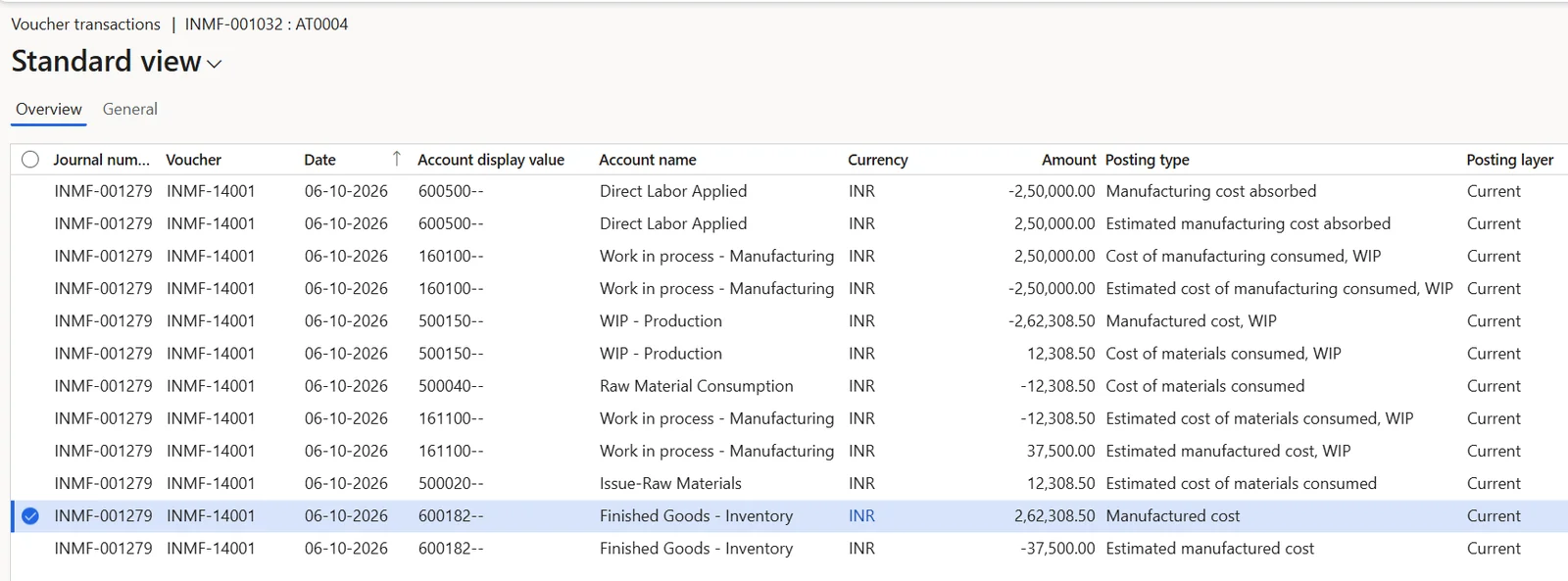
Voucher transactions – End
- Financial movement of goods:
- Financial voucher, financial date and financial cost are recorded. Raw material issues change from Deducted to Sold, and the finished goods receipt changes from Received to Purchased.
- Finished goods are valued at the realized cost of 2,62,308.50 (materials 12,308.50 + labour 2,50,000.00), replacing the estimated cost of 37,500.00 posted at report as finished. No production variance is posted because the finished item is not on the standard cost model.
- The actual labour WIP is posted to 160100 Work in process - Manufacturing (from the cost category), while the manufactured cost is credited to 500150 WIP - Production (from the inventory posting profile). The two accounts carry offsetting balances of 2,50,000.00 and net to zero together.
Each step plays a vital role in ensuring seamless operations and accurate financial reporting. Understanding the financial impact of these events can help manufacturers maximize efficiency and maintain compliance.
Main Account Name | Opening Balance | Debit (INR) | Credit (INR) | Closing Balance |
|---|---|---|---|---|
Bank Account - INR | -9,00,000.00 | - | - | -9,00,000.00 |
CGST recoverable | 81,900.00 | - | - | 81,900.00 |
SGST recoverable | 81,900.00 | - | - | 81,900.00 |
Work in process - Manufacturing | - | 5,49,808.50 | 2,99,808.50 | 2,50,000.00 |
TDS on Purchase | -81,900.00 | - | - | -81,900.00 |
Issue-Raw Materials | - | 12,308.50 | 12,308.50 | - |
Raw Material Consumption | - | - | 12,308.50 | -12,308.50 |
WIP - Production | - | 12,308.50 | 2,62,308.50 | -2,50,000.00 |
Cash Discounts | -900.00 | - | - | -900.00 |
Raw Materials Receipts | 8,19,000.00 | - | - | 8,19,000.00 |
Finished Goods - Inventory | - | 2,99,808.50 | 37,500.00 | 2,62,308.50 |
Direct Labor Applied | - | 2,50,000.00 | 5,00,000.00 | -2,50,000.00 |
Total | - | 11,24,234.00 | 11,24,234.00 | - |
Observations from the trial balance:
- Opening balances are the closing balances of Part 1 (Procure to Pay); the Debit and Credit columns are the postings of this production cycle.
- Issue-Raw Materials nets to zero, confirming that the estimated material posting was fully reversed when the order was ended.
- Work in process - Manufacturing (debit 2,50,000.00) and WIP - Production (credit 2,50,000.00) carry offsetting balances because labour WIP and manufactured cost WIP are mapped to different main accounts; together the WIP balance is nil.
- Raw material stock reduces from 8,19,000.00 to 8,06,691.50 (Raw Materials Receipts 8,19,000.00 – Raw Material Consumption 12,308.50); the balance remains in stock.
- Finished Goods - Inventory carries 2,62,308.50, being materials consumed of 12,308.50 plus labour absorbed of 2,50,000.00. These finished goods are sold in Part 3.
- Direct Labor Applied carries a credit of 2,50,000.00, being the labour cost capitalised into finished goods.
Particulars | Amounts (2026-27) |
|---|---|
Other Income | 900.00 |
Total Income | 900.00 |
Expenses | |
Absorbed production costs (Direct Labor Applied) | -2,50,000.00 |
Total Expenses | -2,50,000.00 |
Profit Before Exceptional Items and Tax | 2,50,900.00 |
Exceptional Items | - |
Profit Before Tax | 2,50,900.00 |
Profit After Tax for the Year | 2,50,900.00 |
Total Comprehensive Income for the year | 2,50,900.00 |
The production cycle itself moves cost from raw materials to finished goods within the balance sheet. The profit and loss statement carries the cash discount of 900.00 from Part 1 and the labour absorption credit of 2,50,000.00 from this cycle. In a live ledger the matching actual wages are posted separately through payroll or accounts payable, so the net result reflects the under- or over-absorption of labour cost rather than a profit.
Particulars | Amounts (2026-27) |
|---|---|
ASSETS | |
Current Assets | |
(a) Inventories | |
Raw materials | 8,06,691.50 |
Finished goods | 2,62,308.50 |
(b) Financial Assets | |
(ii) Cash and Cash Equivalents | -9,00,000.00 |
(d) Other Current Assets | 1,63,800.00 |
Total Current Assets (B) | 3,32,800.00 |
TOTAL ASSETS | 3,32,800.00 |
EQUITY AND LIABILITIES | |
Equity | |
(b) Other Equity | 2,50,900.00 |
Total Equity (D) | 2,50,900.00 |
Liabilities | |
Current Liabilities | |
(d) Current Tax Liabilities (Net) | 81,900.00 |
Total Current Liabilities (F) | 81,900.00 |
TOTAL EQUITY AND LIABILITIES | 3,32,800.00 |
Inventories now total 10,69,000.00: raw materials of 8,06,691.50 and finished goods of 2,62,308.50. The increase of 2,50,000.00 over Part 1 is the labour cost absorbed into finished goods, matched by the same increase in Other Equity. Cash, GST recoverable and TDS payable are unchanged from Part 1, as the production cycle has no cash or tax impact.